

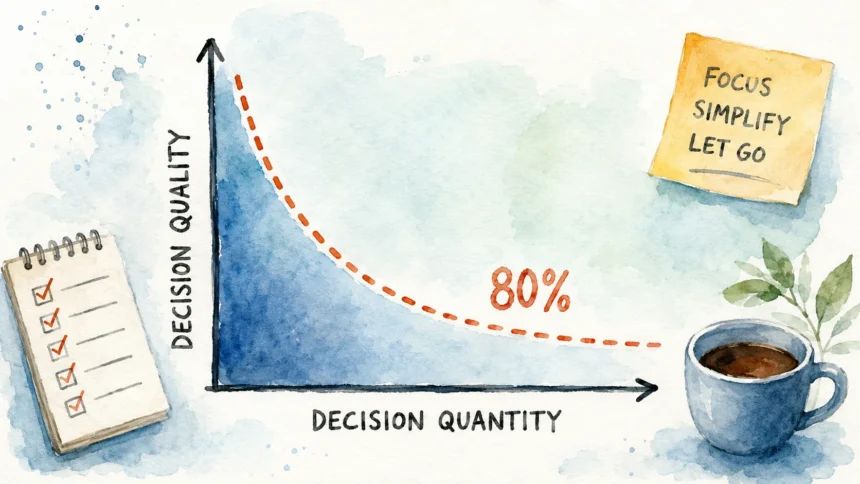
You know that feeling when it’s 6 PM, you haven’t decided what’s for dinner, and somehow that one tiny decision feels harder than anything else you did all day at work? That’s Decision Fatigue happens when too many small choices drain your mental energy, but the 80 Percent Rule can help you stop overthinking and make decisions with more confidence and it’s not a character flaw. It’s just what happens when your brain runs out of decision-making fuel.
The 80 percent rule is a simple idea that fixes this without needing willpower, apps, or complicated systems. The basic idea is this: if you’re 80 percent sure about something, that’s enough to decide and move on. You don’t need 100 percent certainty for most choices in life, and chasing that last 20 percent is exactly what’s draining you.
This article breaks down what decision fatigue actually is, why it quietly wrecks your evenings and your energy, and how the 80 percent rule gives you a practical way out, one that a busy parent, a tired employee, or an overwhelmed student can actually use today.
What Decision Fatigue Really Feels Like
Decision fatigue doesn’t show up as a dramatic collapse. It shows up as small, annoying moments where normal choices suddenly feel impossible.
You stand in front of your closet and can’t pick an outfit, even though you have plenty of clothes that would work fine. You order the same thing at a restaurant every time, not because you love it, but because choosing something new feels like too much effort. You say “I don’t know, you pick” more often than you used to, even about things you actually care about.
| Sign of Decision Fatigue | What It Looks Like in Real Life |
|---|---|
| Avoiding small choices | “You choose the restaurant, I don’t care” |
| Repeating the same choices | Ordering the same meal every single time |
| Feeling drained by simple decisions | Staring at a menu for ten minutes |
| Snapping at small requests | Getting irritated when asked “what do you want for dinner” |
| Procrastinating on decisions | Leaving emails unanswered because replying means deciding something |
A workplace psychologist who studies burnout patterns described it well: “People think burnout comes from big, dramatic stress. Most of the time, it’s death by a thousand small decisions, each one small enough to seem harmless, but they add up across the day until there’s nothing left for the important ones.”
Why Your Brain Runs Out of Decision Fuel

Your brain doesn’t have unlimited energy for decision-making. Every choice you make, big or small, pulls from the same mental resource, and that resource genuinely depletes as the day goes on.
This isn’t a metaphor. Researchers who study this call it ego depletion, and while the exact science is still debated in some areas, the everyday pattern is something almost everyone recognizes without needing a study to prove it. You make sharper, easier decisions in the morning, and by evening, even small choices feel heavier.
| Time of Day | Typical Decision-Making Energy |
|---|---|
| Morning | Highest, decisions feel easier |
| Midday | Starts declining, especially after busy meetings or tasks |
| Late afternoon | Noticeably lower, small choices feel like a burden |
| Evening | Often lowest, “I don’t care, you pick” becomes common |
Knowing this pattern matters, because it explains why trying to make a big decision at 9 PM after a long day rarely goes well, and why the 80 percent rule becomes especially useful during these lower-energy hours.
Where the 80 Percent Rule Actually Comes From
The 80 percent rule isn’t some brand new trick. It borrows from a much older idea sometimes called “good enough” decision-making, where instead of searching for the single best option, you pick the first option that clearly meets your needs well enough.
This connects to a concept researchers call satisficing, a mix of “satisfy” and “suffice.” People who satisfice tend to make decisions faster, feel less regret afterward, and report higher overall happiness with their choices, compared to people who try to maximize every single decision by comparing every possible option.
| Decision Style | How It Works | Common Result |
|---|---|---|
| Maximizing | Searching for the absolute best option every time | Slower decisions, more regret, more fatigue |
| Satisficing (the 80 percent idea) | Picking the first option that’s clearly good enough | Faster decisions, less regret, more energy left over |
A decision-making coach who works with executives put it simply: “The people who seem the most decisive aren’t smarter than everyone else. They’ve just given themselves permission to stop at ‘good enough’ instead of chasing perfect.”
What the 80 Percent Rule Actually Means in Practice
The rule is simple on purpose. If you’re roughly 80 percent confident that a choice is right, or good enough, you commit to it and stop deliberating. You don’t wait for 100 percent certainty, because for most everyday decisions, that certainty never really arrives anyway.
This doesn’t mean being careless. It means recognizing that the last 20 percent of certainty usually costs way more time and energy than it’s worth, especially for decisions that aren’t life-changing.
| Decision Type | Does It Need 100 Percent Certainty? |
|---|---|
| What to eat for lunch | No, 80 percent is more than enough |
| Which show to watch tonight | No, any reasonable option works |
| Buying a house | Maybe closer to 95 to 100 percent, given the stakes |
| Choosing a doctor for a serious surgery | Yes, higher certainty matters here |
| Picking a shirt to wear | Definitely not, this barely needs 50 percent |
The key insight is matching your certainty requirement to the actual size of the decision, instead of treating every choice, big or small, with the same intense level of consideration.
Why Most People Get This Backwards
Here’s the pattern that quietly wrecks so many people’s days: they apply maximum effort to small decisions and rushed effort to big ones. It should really be the opposite.
Someone might spend twenty minutes deciding what to order for lunch, then make a big financial decision in five rushed minutes because they’re mentally exhausted from all the smaller choices earlier in the day. The energy gets spent in the wrong place.
| Backwards Pattern | Better Pattern |
|---|---|
| 20 minutes choosing a lunch order | 2 minutes, pick anything reasonable |
| 5 rushed minutes on a big financial decision | Save energy earlier so this gets proper attention |
| Long debate over which movie to watch | Quick pick, since it barely matters either way |
| Rushed decision about changing jobs | Full, unhurried consideration, since this actually matters |
Applying the 80 percent rule to small decisions frees up the mental energy that big decisions actually deserve.
A Simple Way to Sort Your Daily Decisions
Before you can use the 80 percent rule effectively, it helps to sort decisions into rough categories. Not every choice deserves the same amount of thought, and being honest about which category something falls into makes the whole process much easier.
Low-stakes decisions are ones where any reasonable option works fine and the outcome barely matters a week later. Medium-stakes decisions have some real impact but are reversible or correctable if they don’t work out. High-stakes decisions are ones with lasting consequences that are hard or expensive to undo.
| Category | Example | Suggested Certainty Needed |
|---|---|---|
| Low-stakes | What to eat, what to wear, which show to watch | 50 to 70 percent is fine |
| Medium-stakes | Which apartment to rent, which job offer among similar ones | 80 percent is a good target |
| High-stakes | Major surgery, marriage, buying a home | 90 to 100 percent, worth the extra time |
Most decision fatigue comes from treating low-stakes decisions like they belong in the high-stakes category, which drains energy that should be saved for things that actually deserve it.
How to Actually Use the 80 Percent Rule Today
Knowing the idea is one thing. Actually applying it in daily life is where most people struggle, mostly because old habits of overthinking are hard to break without a clear, simple process.
Start by naming the decision out loud or in your head, then ask yourself honestly: “Am I roughly 80 percent sure this is a fine choice?” If yes, commit immediately without circling back to compare more options. If you’re genuinely below that threshold, that’s a signal the decision might actually be medium or high-stakes, and deserves more thought, not less.
| Step | What To Do |
|---|---|
| Name the decision clearly | “What should I make for dinner tonight?” |
| Ask the 80 percent question | “Am I roughly 80 percent sure this option works?” |
| If yes | Commit immediately, stop comparing |
| If no | Recognize this might be a bigger decision needing real thought |
A therapist who works with anxious clients on decision-making shared a helpful phrase she gives people: “Good enough now beats perfect never. Most of my clients aren’t struggling because their choices are bad. They’re struggling because they can’t let a decision be simply fine.”
Common Mistakes People Make With This Rule
Like most simple ideas, this one gets misapplied in a few predictable ways. Knowing these mistakes ahead of time helps you avoid falling into them.
One common mistake is applying the rule to genuinely important decisions where more thought really is warranted, using it as an excuse to rush things that deserve care. Another mistake is using the 80 percent threshold as an excuse for actual carelessness, like skipping basic research on something that clearly needed it. A third mistake is going back and reopening a decision after committing to it, which defeats the entire purpose of the rule in the first place.
- Using the rule on high-stakes decisions that genuinely deserve more thought
- Confusing “good enough” with “not caring at all”
- Reopening a decision after already committing to it
- Applying the rule inconsistently, only when convenient
- Forgetting that the rule is about stopping analysis, not skipping it entirely
| Mistake | Why It Backfires |
|---|---|
| Using it for major life decisions | Some choices genuinely need more than 80 percent certainty |
| Treating it as an excuse for laziness | The rule assumes basic reasonable thought still happens first |
| Reopening a settled decision | Brings back the same fatigue you were trying to avoid |
| Applying it only sometimes | Inconsistency means old overthinking habits creep back in |
Why Perfectionism Feeds Decision Fatigue So Much
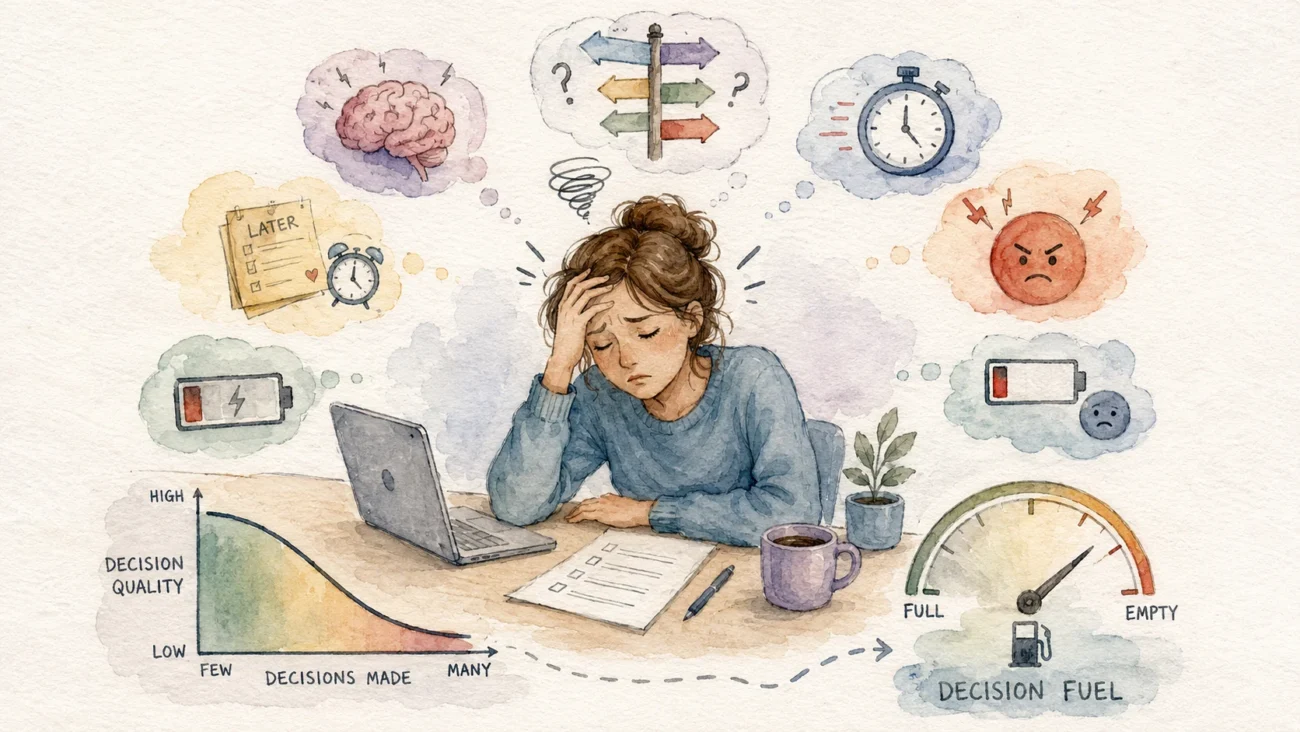
Perfectionism and decision fatigue are close cousins. If you believe every choice needs to be the objectively best one, you’re setting yourself up for exhaustion, since “the best” is often impossible to know in advance anyway.
Perfectionist thinking assumes there’s one correct answer hiding somewhere, and your job is to find it through enough research, comparison, and worry. In reality, for most everyday decisions, several options would have worked out just fine, and the anxiety of finding “the one” is doing far more harm than any wrong choice ever would.
| Perfectionist Belief | More Realistic Belief |
|---|---|
| There’s one perfect choice out there | Several choices would likely work out fine |
| More research always leads to a better decision | More research often just delays the same outcome |
| A wrong choice is a disaster | Most choices are reversible or simply not that critical |
| Certainty should come before deciding | Certainty often comes after deciding and moving forward |
The Difference Between Reversible and Irreversible Decisions
This distinction deserves its own attention, since it’s one of the clearest ways to figure out how much certainty a decision actually needs.
A reversible decision is one you can undo or adjust later without major cost. An irreversible decision is one that’s hard, expensive, or impossible to take back once made. The 80 percent rule fits reversible decisions extremely well, since even if the choice turns out imperfect, you can adjust course without much damage.
| Decision Type | Example | Rule That Applies Best |
|---|---|---|
| Reversible | Trying a new restaurant, switching a workout routine | 80 percent rule works great |
| Semi-reversible | Signing a one-year lease, taking a new job | 80 percent rule, with a bit more care |
| Irreversible | Having a child, major surgery, selling a family home | Needs closer to full certainty, more time is worth it |
A useful habit is asking yourself directly: “If this doesn’t work out, can I fix it later?” If the answer is yes, that’s a strong signal the 80 percent rule applies perfectly here.
How This Rule Helps With Parenting Decisions
Parents deal with an enormous number of small daily decisions, which makes them especially prone to decision fatigue by the end of the day. The 80 percent rule can be genuinely useful here, though it needs a bit of nuance.
Deciding what to pack for lunch, which activity to do after school, or what bedtime story to read are all classic low-stakes decisions where 80 percent certainty, or honestly even 50 percent, is more than enough. Bigger decisions, like which school to choose or how to handle a serious behavior issue, deserve the fuller attention that comes from not being burned out by dozens of smaller choices earlier in the day.
| Parenting Decision | Suggested Approach |
|---|---|
| What snack to pack | Quick pick, 80 percent rule applies easily |
| Which park to visit this weekend | Quick pick, doesn’t need much thought |
| Choosing a school | Deserves careful, unhurried consideration |
| Handling a serious behavioral concern | Deserves full attention, not rushed |
A parenting coach who works with overwhelmed parents shared an honest observation: “Parents burn out partly from the emotional load of parenting, but a huge chunk of it is just decision volume. Snacks, outfits, screen time limits, bedtime negotiations. Giving yourself permission to decide quickly on the small stuff protects your patience for the moments that really need it.”
Using the 80 Percent Rule at Work
Workplaces are full of decisions, and applying this rule at work can genuinely change how draining a workday feels, especially for people in roles involving constant small choices.
Deciding how to word a routine email, which meeting time works, or how to format a simple document rarely needs extended deliberation. Save your full mental effort for decisions that actually shape outcomes, like a major project direction, a hiring choice, or a strategic pivot.
| Work Decision | Suggested Approach |
|---|---|
| Wording of a routine email | Quick, 80 percent rule fits well |
| Choosing a meeting time | Pick any reasonable option, move on |
| Formatting a simple document | Doesn’t need extended thought |
| Choosing a new hire | Deserves careful, full consideration |
| Deciding on a major project direction | Worth the extra time and higher certainty |
A productivity consultant who works with corporate teams noted something worth remembering: “I’ve watched talented people burn an entire morning on font choices for a presentation, then rush the actual content in the last twenty minutes before a big meeting. Energy went to the wrong place entirely.”
Why Waiting for More Information Doesn’t Always Help
There’s a common belief that gathering more information always leads to a better decision. In reality, past a certain point, more information adds very little value while draining a lot more time and energy.
This is sometimes called the point of diminishing returns. The first bit of research on a decision usually gives you the most useful insight. Every additional hour spent after that tends to add smaller and smaller amounts of real clarity, even though it feels productive in the moment.
| Time Spent Researching | Typical Value Gained |
|---|---|
| First 10 minutes | High value, covers the basics clearly |
| Next 30 minutes | Moderate value, fills in some detail |
| Next hour | Small value, mostly repeats what you already knew |
| Beyond that | Very little added value, mostly just delay |
Recognizing when you’ve hit this point, and choosing to stop rather than keep digging, is exactly what the 80 percent rule is training you to do.
How to Handle the Discomfort of Not Being 100 Percent Sure
A big part of why people struggle with this rule isn’t logical, it’s emotional. Sitting with 80 percent certainty instead of 100 percent can genuinely feel uncomfortable, especially for people who like control and predictability.
This discomfort is normal, and it fades with practice. The first few times you commit to a decision at 80 percent certainty, you might feel a small itch of doubt. Over time, as you notice that most of these decisions turn out perfectly fine, that discomfort naturally shrinks.
| Early Practice | With More Practice |
|---|---|
| Noticeable discomfort sitting with uncertainty | Discomfort fades as trust builds |
| Urge to double-check or reconsider | Easier to let the decision rest |
| Feels risky to commit without full certainty | Feels normal and even relieving |
A Practical Daily Exercise to Build This Habit
Like any new habit, the 80 percent rule works better with a bit of deliberate practice rather than just reading about it and hoping it sticks.
Pick one full day and commit to applying the rule specifically to small decisions, things like meals, outfits, and minor tasks. Each time you catch yourself overthinking one of these, pause and ask the simple question: “Am I roughly 80 percent sure?” If yes, decide immediately and move forward without looking back.
| Day Focus | What To Practice |
|---|---|
| Day one | Apply the rule only to meal choices |
| Day two | Add clothing and small daily tasks |
| Day three | Add work-related small decisions |
| End of week | Notice how much mental energy feels different by evening |
Signs the 80 Percent Rule Is Actually Working for You
It helps to know what improvement actually looks like, since change is often gradual and easy to miss if you’re not paying attention to the right signs.
You’ll likely notice yourself making small decisions faster without the usual mental back and forth. Evenings might start feeling less mentally drained, since fewer decisions are quietly eating away at your energy throughout the day. You may also notice less regret over small choices, since you’re spending less time comparing them to imaginary better options after the fact.
| Sign of Progress | What It Looks Like |
|---|---|
| Faster small decisions | Choosing lunch or an outfit without lingering |
| Less evening exhaustion | Feeling more mentally present by dinner time |
| Less regret over small choices | Not replaying “what if I’d picked differently” |
| More energy for bigger decisions | Feeling clearer and calmer when a real decision comes up |
When It’s Okay to Ignore the 80 Percent Rule
This rule isn’t meant to apply universally to every single choice in life, and knowing when to set it aside is just as important as knowing when to use it.
Decisions involving safety, health, legal matters, or long-term irreversible consequences deserve full attention and higher certainty, even if that means more time and effort. The rule exists to protect your energy for exactly these moments, not to rush through them too.
| Situation | Should You Use the 80 Percent Rule? |
|---|---|
| Choosing what to wear today | Yes, definitely |
| Picking a restaurant for dinner | Yes, definitely |
| Choosing a surgeon for a serious procedure | No, take the extra time needed |
| Signing a long-term contract | No, worth slowing down for |
| Deciding whether to end a relationship | No, this deserves full, unhurried thought |
Frequently Asked Questions
What exactly is the 80 percent rule for decision fatigue?
It’s the idea that once you’re roughly 80 percent confident a choice is good enough, you commit to it and stop deliberating, rather than chasing full certainty on every decision.
Does this mean I should be careless with my choices?
No, the rule assumes you’ve already done a reasonable amount of basic thinking. It just stops you from over-researching or over-comparing past the point where it actually helps.
How do I know if a decision needs more than 80 percent certainty?
Ask whether the decision is reversible. If you can adjust or undo it later without major cost, 80 percent is usually enough. If it’s permanent or very costly to reverse, it deserves more thought.
Why does decision fatigue get worse later in the day?
Your brain’s capacity for decision-making isn’t unlimited, and it tends to decline the more choices you make throughout the day, which is why evening decisions often feel harder than morning ones.
Can this rule actually reduce stress, or is it just about speed?
Both. Faster decisions on small things free up mental energy, which reduces overall stress and leaves more patience and clarity for decisions that genuinely matter.
What if I commit to a decision at 80 percent and it turns out wrong?
That’s normal and expected sometimes. The rule accepts that occasional imperfect outcomes are a fair trade for saving huge amounts of time and energy across dozens of daily decisions.
Is this rule the same as just not caring about your choices?
No, it’s about caring appropriately based on how much a decision actually matters, rather than treating every choice, big or small, with the same intense level of consideration.