

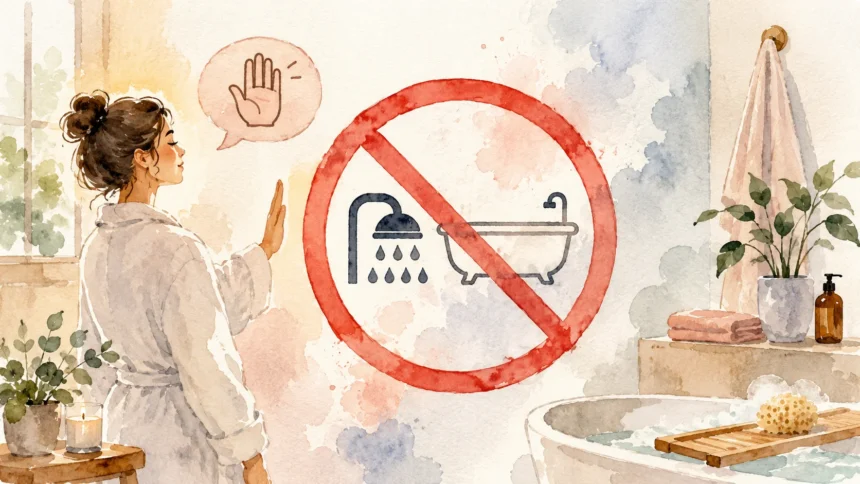
If you have ever stood in the How To Say No can feel difficult when you worry about disappointing people, but clear boundaries help you protect your time, energy, and peace. through an entire conversation in your head, arguing both sides, changing your wording five times, and still walked out without saying anything to the actual person you already know exactly what this article is about. Saying no should be simple. For a lot of people, it turns into a mental rehearsal marathon that never even makes it to the real conversation.
This is not really about vocabulary. Most people already know the word “no.” What they struggle with is the fear, the guilt, and the story in their head about what will happen if they say it out loud. This article breaks down why that happens, what is actually going on in your brain during that shower rehearsal, and how to get to a place where you can say no in the moment, calmly, without needing a script or a private practice session first.
This is written from real patterns seen in coaching conversations, therapy discussions, and plain everyday life, not from a textbook. If you have ever agreed to something you did not want to do just to avoid an awkward pause, this one is for you.
Why Your Brain Rehearses how to say no without feeling guilty Instead of Just Saying It
Your brain treats saying no as a small social risk, even when logically it should not be a big deal. This is not weakness. It is a very old survival instinct that once mattered a lot more than it does now.
Humans evolved in small groups where being disliked or excluded could genuinely threaten survival. Saying no to someone in the group could mean losing support, food, or protection. Your brain still runs on some of that old software, even though saying no to a coworker’s Friday night plan will not get you kicked out of the tribe.
| What Your Brain Thinks | What Is Actually True |
|---|---|
| Saying no might make them reject me | Most people forget the no within a day |
| I need the perfect wording | A plain, short no works just fine |
| I have to explain myself fully | A short reason, or no reason, is enough |
| This will damage the relationship | Healthy relationships survive a no easily |
| I should rehearse until it feels safe | Rehearsing usually increases anxiety, not confidence |
A therapist who works with people on assertiveness training put it this way: “The shower rehearsal is not preparation. It is anxiety pretending to be preparation. Real preparation takes two minutes. The shower version takes twenty and usually makes people more nervous by the end, not less.”
The Real Reason Rehearsing Doesn’t Actually Help
It feels productive to run through the conversation in your head. It feels like you are getting ready. But there is a difference between preparing and spiraling, and most shower rehearsals fall into the second category.
When you rehearse a hard conversation over and over, you are not practicing calm delivery. You are practicing worst case scenarios. Your brain keeps generating new ways the other person might react badly, and each new version adds a little more anxiety rather than confidence.
This is different from something like practicing a speech, where repetition genuinely improves performance. A no does not need performance. It needs clarity. Overthinking a simple boundary usually makes the moment harder, not easier, because by the time you actually face the person, you have built up ten imaginary bad reactions in your head that have nothing to do with what they will actually say.
| Type of Practice | What It Actually Trains |
|---|---|
| Practicing a speech | Delivery, timing, confidence |
| Rehearsing a “no” in the shower | Anxiety, worst-case imagination |
| Saying “no” out loud once, calmly | Real confidence, real skill |
What People Usually Get Wrong When Trying to Say No
Before getting into what actually works, it helps to look at common mistakes people make, since these mistakes are often the real reason saying no feels so hard in the first place.
Over-explaining is one of the biggest ones. People often think a longer explanation makes the no more acceptable, but in reality it usually just gives the other person more angles to push back on. Apologizing excessively is another common mistake, where a simple no turns into three sentences of sorry before the actual answer even comes out. Waiting too long to respond is also common, since people often say yes just because staying silent felt more uncomfortable than agreeing.
- Giving a long explanation instead of a short one
- Apologizing multiple times before the actual answer
- Saying yes first and trying to back out later
- Avoiding eye contact or mumbling the answer
- Agreeing to think about it just to delay discomfort, then forgetting to follow up
A workplace communication coach shared an observation that comes up constantly in her sessions: “People believe a longer no sounds more polite. Actually the opposite tends to be true. A short, warm no sounds confident. A long, apologetic no sounds like an invitation to negotiate.”
The Shower Rehearsal Pattern: What It Actually Looks Like
It helps to name this pattern clearly, since seeing it written out often makes people realize how familiar it is. The shower rehearsal usually follows a very specific shape.
First, you replay the moment the request was made. Then you imagine several different responses, testing which sounds least confrontational. Next, you imagine how the other person might react to each version, usually assuming the worst possible reaction. Then you add an explanation to soften it. Then you imagine they push back on the explanation, so you add more detail. By the end, you either have an overly complicated response memorized, or you have talked yourself out of saying no at all.
| Stage | What Happens |
|---|---|
| Replaying the request | Mentally reliving the moment they asked |
| Testing responses | Trying different wordings in your head |
| Imagining reactions | Assuming worst-case responses from them |
| Adding explanations | Trying to justify the no in advance |
| Overthinking pushback | Preparing defenses for imaginary arguments |
| Final result | Either an overcomplicated no, or giving up and saying yes |
Recognizing this pattern in the moment is often the first real step toward breaking it, simply because naming it takes away some of its automatic power.
Why a Short No Actually Works Better Than a Long One
There is a strong instinct to soften a no with extra words, extra reasons, and extra apology. In practice, shorter almost always lands better, both for you and for the other person.
A short no sounds decided. A long no sounds uncertain, like you are still convincing yourself while you talk. People pick up on that uncertainty, even if they cannot name it directly, and uncertainty is exactly what invites more pushback.
Here is a simple comparison of how the same request might get handled two different ways.
| Long, Over-Explained No | Short, Clear No |
|---|---|
| “I’m so sorry, I really wish I could, it’s just that I have so much going on this week and I already promised myself I’d rest, and I feel bad saying no but…” | “I can’t make it this time, but thanks for thinking of me.” |
| Leaves room for the other person to offer solutions to your excuses | Leaves no obvious opening to push back |
| Sounds anxious and unsure | Sounds calm and settled |
A useful way to think about it: your reason is for you, not for them. You do not owe a full explanation for most everyday requests. A simple, warm, short response respects both people’s time.
Simple No Scripts That Do Not Need Rehearsal
Having a few ready-made responses in your back pocket removes the need to build a new script from scratch every single time. These are short enough to say without sounding stiff or memorized.
For a request you simply do not want to do: “That’s not something I can take on right now.”
For a social invitation you want to skip: “I appreciate the invite, but I’m going to sit this one out.”
For a work task outside your plate: “I don’t have room for that this week, but thank you for asking.”
For a request from family that feels like pressure: “I’ve thought about it, and I’m going to pass this time.”
For something that needs an instant answer: “I need to say no on this one.”
| Situation | Simple Response |
|---|---|
| Extra work task | “I don’t have room for that this week.” |
| Social event | “I’m going to sit this one out, but thanks for asking.” |
| Favor from a friend | “I can’t help with that this time.” |
| Family pressure | “I’ve decided not to do this one.” |
| Put on the spot | “I need to say no here.” |
None of these need rehearsing. They are short enough to say in the moment they are needed, which is exactly the point.
Why “Because” Is Doing More Damage Than You Think
There is a well known idea in psychology that people are more likely to comply with a request if you give a reason, even a weak one, simply because the word “because” makes a request sound more legitimate. The same idea works in reverse with a no.
When you give a reason for your no, you are handing the other person something to respond to. If your reason is “I’m too tired,” they might offer to help you feel less tired. If your reason is “I don’t have time,” they might offer to make it quick. A no without an attached reason is much harder to argue with, simply because there is nothing there to counter.
This does not mean you should never explain yourself. Close relationships often deserve context. But for smaller everyday requests, a plain no without a built-in excuse tends to end the conversation faster and with less back and forth.
| With a Reason Attached | Without a Reason Attached |
|---|---|
| “I can’t, I’m too busy” → “I promise it’ll be quick” | “I can’t make this one work.” |
| “I’m tired” → “You can rest after, it’s just an hour” | “This isn’t something I’m doing right now.” |
| Reason becomes a target for negotiation | Nothing left to negotiate against |
The Guilt Problem: Why Saying No Feels Wrong Even When It Isn’t
A huge part of the shower rehearsal habit comes down to guilt, not communication skill. Many people were raised in environments, cultures, or families where saying no was treated as rude, selfish, or ungrateful, even when the request itself was unreasonable.
This creates a strange internal rule where agreeing to something you do not want to do feels safer than disappointing someone, even if that agreement costs you time, energy, or peace of mind. The guilt shows up before the words do, which is exactly why the shower rehearsal happens in the first place — you are not practicing wording, you are trying to talk yourself out of guilt that has not even happened yet.
A common pattern worth recognizing: guilt about saying no is often guilt about an imagined reaction, not an actual one. Most people, most of the time, react to a plain no with a simple “okay, no worries,” and the guilt turns out to have been for nothing.
| Guilt Trigger | What Actually Usually Happens |
|---|---|
| “They’ll be upset with me” | Most people accept a no calmly |
| “They’ll think I don’t care” | A warm tone communicates care, not the answer itself |
| “I’ll seem selfish” | Protecting your time is not selfish, it’s normal |
| “They might not ask me again” | Reasonable people do not punish a single no |
How Tone Changes Everything, Even With the Exact Same Words
The words you use matter less than most people assume. Tone carries a huge part of how a no lands, which is good news, since tone is something you can control far more easily than finding the “perfect” wording.
A flat, cold no can feel dismissive even if the words are polite. A warm, steady no, even with very plain wording, usually feels respectful and clear. This is part of why rehearsing wording in the shower often misses the real issue entirely — the problem was never the words, it was the anxious energy behind them.
| Same Words, Different Tone | How It Lands |
|---|---|
| Flat, rushed “I can’t do that” | Feels cold or dismissive |
| Calm, steady “I can’t do that” | Feels honest and clear |
| Apologetic, nervous “I can’t do that, sorry, sorry” | Feels unsure, invites pushback |
| Warm “I can’t do that, but I appreciate you asking” | Feels respectful and settled |
Practicing a calm tone, rather than rehearsing exact wording, is a far better use of any mental prep time you want to do before a hard conversation.
The Difference Between Saying No at Work and Saying No to Family
Not every “no” carries the same weight, and treating every situation the same way often makes things harder than they need to be. Work relationships and family relationships tend to need slightly different approaches.
At work, a no is usually about capacity and priorities, not personal feelings. Framing it around workload or timing tends to land smoothly, since most workplaces understand limited time and competing tasks. With family, a no often carries more emotional history attached to it, meaning the same plain wording that works fine at work might feel harsher in a family setting, where a touch more warmth in tone, without extra apology, tends to help.
| Setting | What Usually Works Best |
|---|---|
| Workplace | Framing around time, workload, or priorities |
| Close friends | Honest, brief, with warmth |
| Family | Slightly more warmth in tone, still short in wording |
| Acquaintances | Simple, polite, no explanation needed |
What to Do When Someone Pushes Back After Your No
Even a clear, short no sometimes gets pushback. Knowing how to handle this without folding back into a yes is its own separate skill, and it is worth having a plan for this specific moment.
The most effective approach is repeating your no in almost the same words, without adding new explanations or getting defensive. This is sometimes called the broken record technique, and it works because it signals that your answer is not up for further negotiation, without you needing to argue your case.
For example, if someone responds to your no with “come on, it’ll only take a few minutes,” a steady response like “I understand, but I still can’t take this on” repeats the boundary without escalating or over-explaining. If they push again, repeating a close variation, calmly, works better than getting pulled into a longer debate.
| Their Pushback | Steady Response |
|---|---|
| “It’ll only take a few minutes” | “I hear you, but I still can’t do this.” |
| “You always say no” | “I know this isn’t what you wanted to hear, but the answer is still no.” |
| “Just this once” | “I understand, and my answer is still no.” |
| “You’re being difficult” | “I’m not trying to be difficult, I just can’t do this one.” |
A Simple Way to Practice Saying No Without It Becoming a Shower Rehearsal
There is a real difference between healthy practice and anxious rehearsing, and it comes down to time and repetition. Healthy practice is short, done once or twice, and focused on tone rather than wording. Anxious rehearsing repeats endlessly and focuses on imagining bad outcomes.
A useful approach is picking one simple phrase, saying it out loud exactly once in a calm voice, and then stopping. If you notice yourself repeating it a fifth or sixth time, or adding new imagined scenarios, that is the moment to catch yourself and step away from the mental loop rather than feeding it further.
| Healthy Practice | Anxious Rehearsing |
|---|---|
| Says the phrase once or twice out loud | Repeats it many times in the head |
| Focuses on calm tone | Focuses on imagining bad reactions |
| Takes a minute or two | Can take twenty minutes or more |
| Leaves you feeling ready | Leaves you feeling more anxious |
Why People With Strong Boundaries Still Feel a Little Uncomfortable Saying No
It is worth normalizing something here: even people who are genuinely good at setting boundaries often still feel a small flicker of discomfort before saying no. The goal is not to eliminate that feeling completely. The goal is to stop letting that feeling control the outcome.
A person with strong boundaries still notices the urge to soften, apologize, or overthink. The real difference is that they say no anyway, without letting the discomfort turn into an hour of mental rehearsal or a caved-in yes. Discomfort and confidence are not opposites. They can exist in the same moment.
| Common Assumption | More Accurate Reality |
|---|---|
| Confident people never feel nervous saying no | Most feel a flicker of discomfort too |
| The goal is to feel completely comfortable first | The goal is acting despite mild discomfort |
| Confidence means the feeling goes away | Confidence means the feeling stops being in charge |
How Saying Yes Too Often Actually Makes Saying No Harder Later
There is a pattern worth pointing out clearly: the more often you say yes to avoid discomfort, the harder saying no becomes over time, not easier. Each yes given out of guilt sets a small expectation that you will likely say yes again next time, which raises the emotional stakes of eventually saying no.
This creates a cycle where people build up resentment from constantly overcommitting, yet feel even more anxious about breaking the pattern, since by that point, a no feels like it is going against a long established habit rather than just answering one single request.
Breaking this cycle usually starts small, with lower stakes situations, rather than trying to fix the hardest relationship first. Saying no to a small request, and noticing that the world does not fall apart, builds the confidence needed for bigger, harder conversations later.
| Starting Point | Why It Works Well |
|---|---|
| Small, low stakes requests | Lower pressure, easier to practice |
| Requests from less emotionally loaded relationships | Less guilt attached, easier first steps |
| Situations with a clear, short answer | Builds confidence without overthinking |
What Actually Happens After You Say No (Based on Real Patterns)
One of the most helpful things you can do is separate what you imagine will happen from what generally, realistically happens after a plain no. Most imagined outcomes during a shower rehearsal are far worse than the actual result.
In the vast majority of everyday situations, a calm no is met with a simple acknowledgment, sometimes mild disappointment, but rarely the dramatic reaction people fear. Genuine anger or lasting damage over a reasonable no is uncommon, and when it does happen repeatedly from the same person, it often says more about that relationship’s overall pattern than about your delivery.
| Imagined Outcome | Common Real Outcome |
|---|---|
| They’ll be furious | Mild disappointment at most, often none at all |
| They’ll bring it up forever | Usually forgotten within days |
| The relationship will suffer | Healthy relationships absorb a no easily |
| They’ll stop liking me | Most people respect a clear, honest answer |
Building a Personal Reminder System for Future Situations
Since the shower rehearsal habit tends to repeat itself across different situations, having a simple, repeatable reminder can help interrupt the pattern before it spirals.
A short mental checklist works well here. Before responding to a request, pause and ask yourself whether you actually want to do this, whether you have the time and energy for it, and whether you are about to say yes purely to avoid discomfort. If the honest answer points toward no, giving yourself permission to say it plainly, without an attached essay of reasons, becomes much easier with this quick pause built in.
| Quick Check Before Responding | What It Reveals |
|---|---|
| Do I actually want to do this? | Separates genuine willingness from guilt |
| Do I have the time and energy? | Grounds the decision in reality, not obligation |
| Am I about to say yes just to avoid discomfort? | Catches the guilt-driven yes before it happens |
Frequently Asked Questions
Why do I rehearse saying no so many times before actually doing it?
Ans: This usually comes from anxiety about the other person’s reaction, not a lack of communication skill. Rehearsing feels productive, but it often just builds more worry rather than making the actual conversation easier.
Is it rude to say no without giving a reason?
Ans: No, a short no without an attached reason is not rude. For most everyday requests, a plain answer is perfectly respectful, and giving a reason often just opens the door for the other person to argue against it.
What if the person gets upset after I say no?
Ans: Mild disappointment is normal and does not mean you did anything wrong. If someone reacts with lasting anger over a reasonable, calmly delivered no, that reaction says more about them than about how you handled it.
How do I say no to someonemake people stop liking me?
Ans: Generally, no. People tend to respect others who are honest about their limits more than people who constantly overcommit and later seem resentful or unreliable.
What should I do if I already said yes but I really wanted to say no?
Ans: It is reasonable to circle back and revise your answer, especially if you catch it soon after agreeing. A simple message like “I said yes earlier, but after thinking it over, I actually can’t take this on” is completely acceptable.
Does practicing what to say ever actually help?
Ans: Yes, briefly. Saying your response out loud once or twice, focused on a calm tone rather than perfect wording, is genuinely useful. The problem is not practice itself, it’s repeating it for twenty minutes while imagining worst case reactions.